


Taking CBD for the very first time
Feeling your best starts with the right CBD dose.
How much CBD you need comes down to these key factors:
- Body weight
Heavier bodies require higher doses of cannabidiol (CBD) to experience benefits. - Individual cannabinoid tolerance
Your sensitivity to CBD and other cannabinoids affects how strongly you feel a given dose. - Primary wellness goals
Goals like everyday relief, inflammation support, deep relaxation, and sleep balance may call for different CBD dosage ranges.
Of the three, body weight shapes your dosage needs the most, so we’ll start there.
CBD Dosage Calculator: Personal product and dose recommendations
How much CBD to take
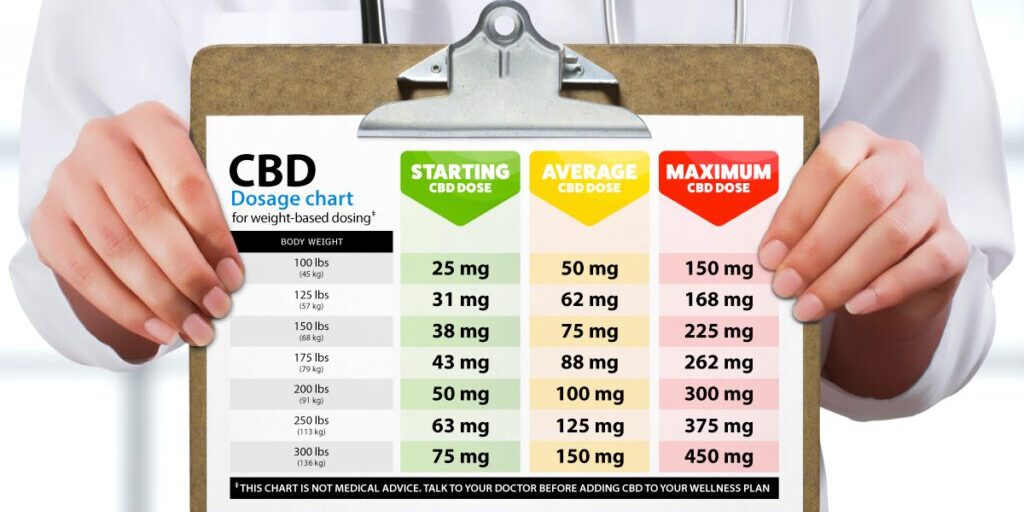
Body weight is the most reliable starting point for determining your CBD dose.
Clinical research shows that cannabinoid response follows predictable dosage ranges, making weight-based guidance a dependable way to simplify CBD dosing.²
First, choose a dosage strength—starter, optimal, or maximum—then find your weight and recommended dose:
Weight-Based CBD Dosage Chart |
||||
|---|---|---|---|---|
| Weight | Starter Strength Dose |
Optimal Strength Dose |
Maximum Strength Dose |
Recommended Product |
| 100 lbs (45 kg) |
25 mg | 50 mg | 150 mg | Starter: 750 mg CBD Oil Optimal: 1500 mg CBD Oil Maximum: 3000 mg CBD Oil |
| 125 lbs (57 kg) |
31 mg | 62 mg | 188 mg | Starter: 750 mg CBD Oil Optimal: 1500 mg CBD Oil Maximum: 6000 mg CBD Oil |
| 150 lbs (68 kg) |
38 mg | 75 mg | 225 mg | Starter: 1500 mg CBD Oil Optimal: 3000 mg CBD Oil Maximum: 6000 mg CBD Oil |
| 175 lbs (79 kg) |
43 mg | 88 mg | 262 mg | Starter: 1500 mg CBD Oil Optimal: 3000 mg CBD Oil Maximum: 6000 mg CBD Oil |
| 200 lbs (91 kg) |
50 mg | 100 mg | 300 mg | Starter: 1500 mg CBD Oil Optimal: 3000 mg CBD Oil Maximum: 12000 mg CBD Oil |
| 250 lbs (113 kg) |
63 mg | 125 mg | 375 mg | Starter: 1500 mg CBD Oil Optimal: 3000 mg CBD Oil Maximum: 12000 mg CBD Oil |
| 300+ lbs (136 kg) |
75 mg | 150 mg | 450 mg | Starter: 3000 mg CBD Oil Optimal: 6000 mg CBD Oil Maximum: 12000 mg CBD Oil |
Weight-based CBD dosage recommendations fall within established safety margins. Even better, they’re grounded in clinical research evaluating dosing thresholds and reported side effects across many intake levels.³
Looking to get more hands-on with your CBD wellness plan?
Learn how to calculate your own CBD dose using clinically effective ranges applied in scientific studies. This step-by-step guide includes everyday examples from real-world CBD users just like you.
How often to take CBD
Most people do best taking CBD once or twice per day. It’s simple, effective, and easy to stick with.
Some users prefer to divide their recommended daily amount into smaller, microdoses taken every 1-2 hours.
Microdosing is thought to maintain more consistent levels of CBD in the body, minimizing peaks and dips—especially on long or demanding days.
Whether you choose CBD oil tinctures, softgels, or gummies, regular use helps reinforce benefits that carry forward into the days and weeks ahead.
When to expect CBD benefits
How quickly you experience benefits and how long they last depends primarily on the CBD delivery method you choose.
Compare the five most popular delivery methods in the chart below. Notice how some act fast but fade quickly, while others take more time to kick in and have longer-lasting effects:
Compare CBD Delivery Methods |
||||
|---|---|---|---|---|
| Delivery Method | Bioavailability | Onset Time | Peak Effects | Total Duration |
| Vaping Inhale |
31%–56% Higher absorption |
Less than 1 minute | Peaks in 10 minutes or less | About 2 hours |
| Sublingual Hold under the tongue |
13%–19% Moderate absorption |
Within 20–30 minutes | Peaks within 1–2 hours | 4–6 hours |
| Oral Take by mouth and swallow |
5%–19% Moderate absorption |
Within 30–60 minutes | Peaks within 2–3 hours | 6–8 hours |
| Topical Apply to target areas |
5% Lower absorption |
Within 30–60 minutes | Peaks within 1–2 hours | 4–6 hours |
| Internal Suppository use |
5% Lower absorption |
Within 30–60 minutes | Peaks within 1–2 hours | 4–6 hours |
You’re not limited to just one CBD delivery method. Stack two or three of them together for added support that helps you feel better in more ways than one.
CBD users often combine sublingual and oral dosing for faster onset and longer-lasting results. Some pair their oil tincture with a topical CBD product for targeted external relief.
Others choose internal delivery methods like CBD suppositories for digestive comfort and reproductive system balance.
Which type of CBD should I try?
Choosing the right CBD product starts with understanding what it’s made of.
Cannabidiol—better known as CBD—is the primary medicinal compound derived from hemp plants and the foundation of all CBD products.
It comes in full spectrum, broad spectrum, and pure isolate varieties. Each has its own advantages and trade-offs, depending on your wellness goals.
Let’s break down the three types of CBD to help you decide which one to try:
Full Spectrum
Delivers the richest cannabinoid profile.
Full spectrum CBD oils are made with minimally processed hemp extract, so they contain a wide range of cannabinoids, terpenes, and flavonoids. They also have trace levels of THC that are within federal legal limits and too tiny to make you feel intoxicated or high.⁴
Research suggests these beneficial plant compounds may work better together, amplifying each other’s individual effects when combined. This natural phenomenon is known as the entourage effect, and some CBD users report enhanced effects and improved benefits because of it.
✅ Full spectrum extracts deliver a robust cannabinoid profile with a hint of THC in the mix for true entourage effects.
Broad Spectrum
All the benefits of a rich cannabinoid profile without THC.
You’ll find a wide range of cannabinoids in broad spectrum CBD oils, but any traces of THC are filtered out until they’re undetectable by standard lab testing.
For many users, the experience with our broad spectrum products feels identical to the full spectrum kind, and it’s a perfectly suitable replacement for anyone avoiding THC.
✅ Broad spectrum products are best if you want the same benefits as full spectrum CBD with no THC.
Pure Isolate
99.7% pure cannabidiol (CBD) that’s THC-free.
CBD isolate is a highly refined form of hemp extract with pharmaceutical-grade purity. It’s ideal for people who don’t like the characteristic flavor of full and broad spectrum CBD, or those avoiding psychoactive cannabinoids.
✅ Isolate delivers radical CBD purity, minimal taste, and—verified by independent labs—absolutely no THC (Delta-8 or Delta-9).
Compare CBD types at a glance
Use the chart below to see how full spectrum, broad spectrum, and CBD isolate match up in a side-by-side comparison.
CBD Comparison Chart |
|||
|---|---|---|---|
| Full Spectrum CBD | Broad Spectrum CBD | Pure CBD Isolate | |
| Contains CBD | Yes | Yes | Yes |
| Minor Cannabinoids (CBN, CBG, CBC) |
Complete profile | Partial profile | None |
| Terpenes | Yes | Trace amounts | None |
| Flavonoids | Yes | Yes | None |
| THC | Up to 0.3% THC | No THC | No THC |
| Aroma | Bright and fragrant | Mild hemp | Odorless |
| Taste | Full-bodied | Light-bodied | Flavorless |
| Color | Deep amber | Light gold | White or clear |
| Base Extract | Full Spectrum Distillate | Broad Spectrum Distillate | Pure Isolate Powder |
| CBD Oil Tincture | Full Spectrum CBD Oil | Broad Spectrum CBD Oil | CBD Isolate Oil |
| CBD Softgels | Full Spectrum CBD Softgels | Broad Spectrum CBD Softgels | - |
| CBD Gummies | Full Spectrum CBD Gummies | Broad Spectrum CBD Gummies | - |
Still not sure which hemp CBD extract is right for you?
Chat with our AI assistant or get real human support from a Cannabiva® team member.
Best time of day to take CBD
Timing your CBD dose with a meal matters more than what time of day you take it.
According to clinical research, dietary fats help boost CBD absorption by up to 1300%.⁵
So, whether you prefer your CBD dose first thing in the morning, during that midday slump, or in the evening before bed, pairing it with food when you take it is the most effective way to maximize how much of it your body actually uses.
Choosing the right CBD oil strength
Every Cannabiva® CBD oil tincture displays the total CBD content in milligrams (mg) on the front of the product label. This number refers to the full container, not the amount of CBD per suggested serving size.
See how different CBD oil strengths break down per drop and per 1 mL dropper in the chart below:
CBD Oil Dosage by Dropper VS Drop |
||
|---|---|---|
| Total CBD In Bottle (30 mL / 1 oz) |
CBD Per Dropper (1 mL dropper) |
CBD Per Drop (30 drops per mL) |
| 100 MG | 3.33 mg | 0.11 mg |
| 250 MG | 8.33 mg | 0.27 mg |
| 500 MG | 16.67 mg | 0.56 mg |
| 750 MG | 25 mg | 0.83 mg |
| 1000 MG | 33.33 mg | 1.11 mg |
| 1500 MG | 50 mg | 1.67 mg |
| 2500 MG | 83.33 mg | 2.78 mg |
| 3000 MG | 100 mg | 3.33 mg |
| 5000 MG | 166.67 mg | 5.56 mg |
| 6000 MG | 200 mg | 6.67 mg |
| 10000 MG | 333 mg | 11.1 mg |
| 12000 MG | 400 mg | 13.33 mg |
Dropper opening sizes can vary slightly. As a result, the number of drops per 1 mL dropperful typically ranges from about 25 to 40.
For consistent single-drop dosing, establish a relative scale using the same dropper. Count how many drops it delivers per 1 mL and note that number for future reference. If you ever switch droppers, simply repeat the process to recalibrate your drop count.
CBD Safety Profile
CBD is safe and generally well-tolerated by healthy adults 21+ when used as directed.
Does CBD cause side effects?
Most people never experience an adverse reaction after taking CBD.
For those who do, side effects tend to be mild and short-lived. Reported side effects include the following:
- Dry mouth
- Increased thirst
- Changes in appetite
- GI discomfort
- Drowsiness
Allergic reactions are rare. You should avoid over-the-counter CBD oil products if you are allergic to any of the ingredients listed on the label.
Is it possible to take too much CBD?
CBD is widely considered safe and non-toxic. It’s non-psychoactive too, and can’t make you feel “high” or “loopy” after you take it. Best of all, you won’t build a tolerance to CBD, so your dose will remain the same over time.
Recommended CBD dosages range from 25 mg to 1,500 mg daily. In human clinical trials, participants were administered up to 35 times more than a standard daily CBD dose to establish safe upper limits. Side effects of these CBD mega doses were reported as mild to moderate.
There are no reports of serious side effects or CBD overdose related to taking excessive amounts.
Talk to your doctor if you think you’ve taken too much CBD.
Can I take CBD with other cannabinoids like CBN and CBG?
Hemp plants naturally produce about a hundred different cannabinoid compounds.
So if you’ve ever taken a full or broad spectrum CBD product, you’ve already safely combined CBD with other cannabinoids.
Stacking cannabinoids with a standalone CBN or CBG product is a smart way to level up your wellness plan using the power of the entourage effect.
Can I take CBD with herbs, supplements, and other natural products?
CBD is not known to interact with other natural products and is widely used alongside herbs, vitamins, and minerals as part of a complete wellness plan.
People most commonly pair dietary supplements for stress relief, mood balance, energy, and sleep difficulty with CBD to enhance their benefits.
Talk to your doctor if you’re new to natural products, have an existing medical condition, or take medication.
Can I take CBD with prescription medications?
CBD is processed by the liver in the same way some prescription medications are. When taken together, CBD may affect how those medicines are broken down and removed from the body.
If you take prescription medications, especially for cardiovascular, kidney, or liver conditions, talk to your doctor before combining them with CBD products.
CBD Dosage FAQ
Everyone’s CBD wellness plan looks a little different. This CBD dosage FAQ covers dosing basics, safety considerations, and what most people want to know before getting started.